
Academics are buried under paper deadlines with zero time for tool hopping. SciSpace vs Elicit is the AI research showdown you need to understand right now—one dominates end-to-end literature workflows with writing tools, the other crushes systematic reviews with transparent data extraction. Pick wrong, and you'll waste weeks relearning a platform mid-project.
SciSpace searches 270+ million papers and drafts your manuscript sections. Elicit analyzes 138+ million sources with sentence-level citations built for evidence synthesis. Your research type determines the winner.
🚥 Quick Verdict: Match Your Tool to Your Deadline 🚥

SciSpace wins for: Multi-language research, AI writing assistance, exploratory lit reviews, Deep Review automation, and PDF explanations that decode complex equations.

Elicit dominates: Systematic reviews, automated screening workflows, data extraction tables, transparent citations, and research alert monitoring.
PhD students juggling chapters and analysis pick SciSpace. Clinical researchers running PRISMA meta-analyses choose Elicit.
⚔ SciSpace vs Elicit at a Glance: Features That Matter
| Feature | SciSpace | Elicit |
|---|---|---|
| Database size | 270+ million papers | 138+ million papers + clinical trials |
| Multi-language papers | Supports 75+ languages | Primarily English |
| AI writing/paraphrasing | Built-in | None |
| Chrome extension | Yes | No |
| Mobile apps | iOS, Android | None |
| Research alerts | No | Yes |
| Zotero integration | Import only | Import + export |
| Systematic review automation | Basic (Deep Review) | Full PRISMA workflow |
| Data extraction tables | Manual + AI assist | Fully automated |
| Free tier generosity | 100 credits | Unlimited search |
⚡ What are SciSpace and Elicit? (Plain Facts)
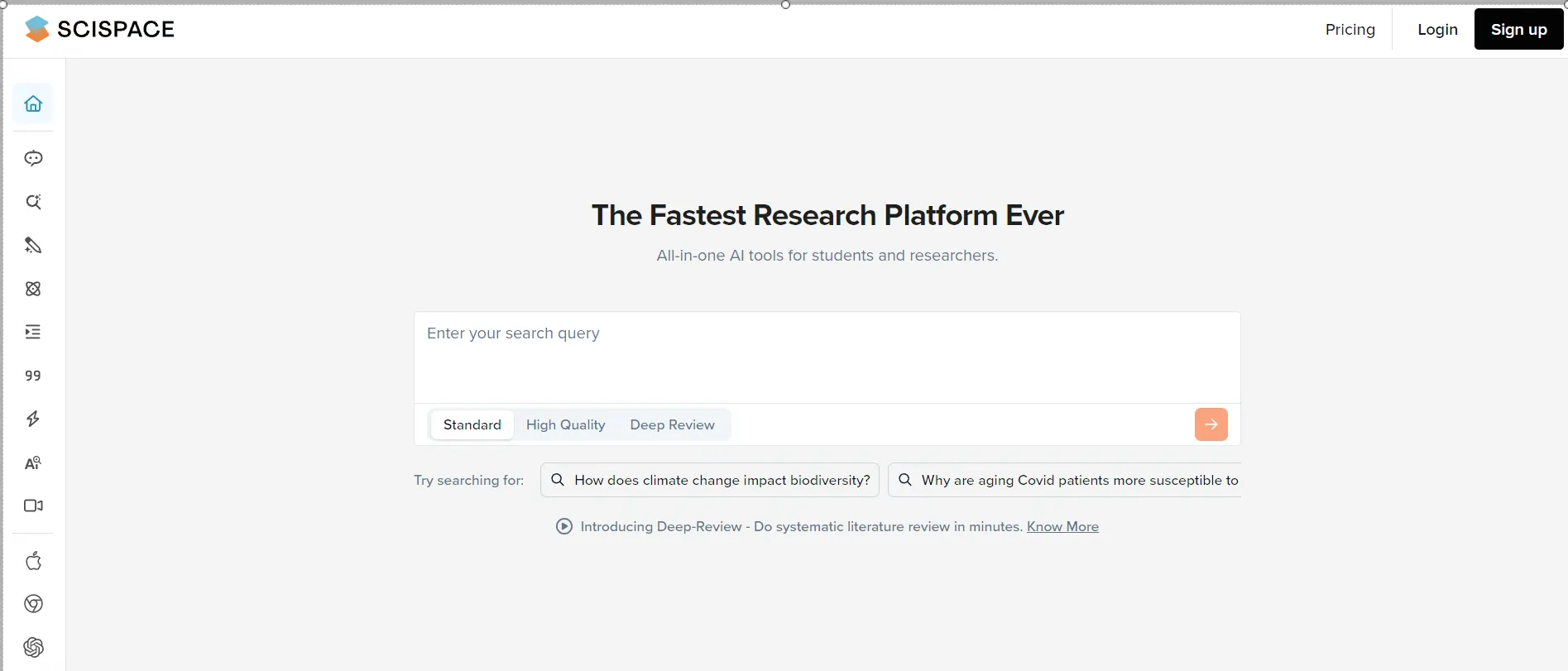
SciSpace is an AI research platform combining semantic search across 270+ million papers, Copilot chat for PDF reading, Deep Review agents for automated literature discovery, and AI writing tools for drafting academic text. Ask questions in plain language, get citation-backed answers, and export publication-ready summaries.
Elicit focuses on fast evidence synthesis. Semantic search covers 138+ million papers plus 545,000+ clinical trials. The core strength: automated data extraction turning PDF stacks into structured comparison tables showing methods, populations, interventions, and outcomes. Built for reproducible systematic review workflows.
⭐ Core Use Cases: When Each Tool Shines
🔎 Search Power and Discovery: Semantic AI Face-Off
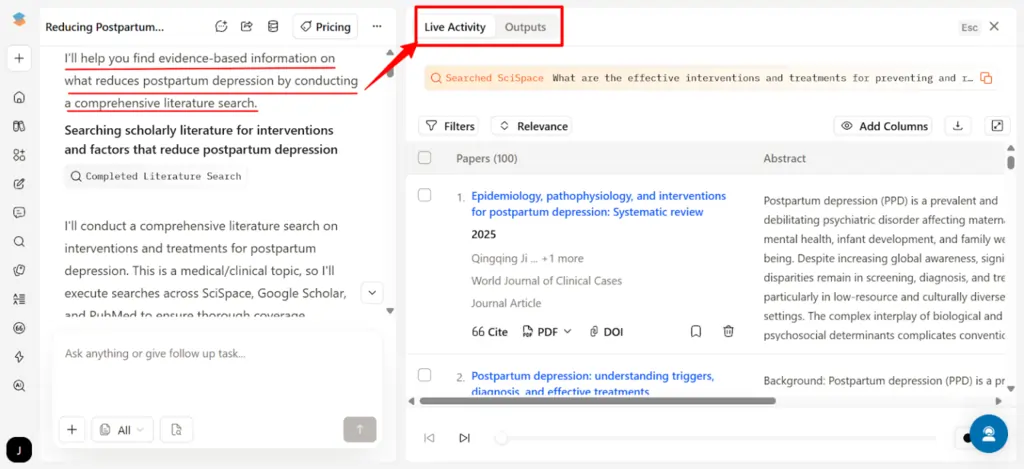
SciSpace handles natural questions like “What reduces postpartum depression?” and returns paragraph summaries with 5-10 citations. Deep Review automates multi-step searches, screens up to 1,750 papers, identifies 300+ relevant ones, clusters themes, and stops when coverage is complete—zero manual sorting required.
Elicit's semantic search emphasizes precision. Type your question, get eight hyper-relevant papers first, then expand your results table. No keyword guessing. No tangential flood. Just papers that actually match your research question with transparent relevance scoring.
📄 PDF Understanding: Interactive Chat vs Structured Extraction
SciSpace Copilot turns static PDFs into conversations. Highlight equations, ask what they mean, get contextual explanations. Upload dozens of papers and search across all simultaneously. Annotate, summarize, and organize everything in a centralized library with export options.
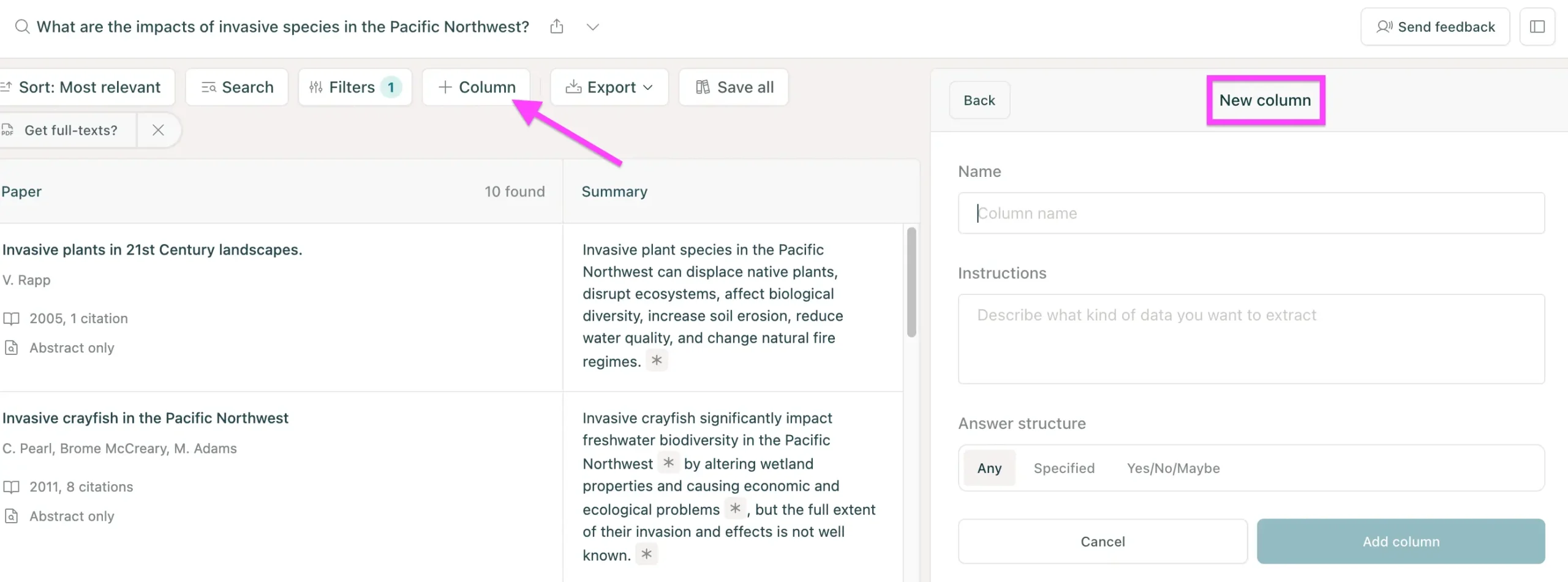
Elicit skips chat for structured tables. Upload papers, define columns (population, intervention, control, outcome), and watch auto-fill magic happen. Need statistical methods compared across 50 studies? Elicit builds that comparison matrix in minutes while you grab coffee.
👉 Systematic Reviews: Automation Styles Compared
SciSpace Deep Review acts like an agentic research assistant—refining queries, running search variations, traversing citations to uncover hidden papers, categorizing by theme, and knowing when enough is enough. Perfect for scoping reviews or mapping new research territories.
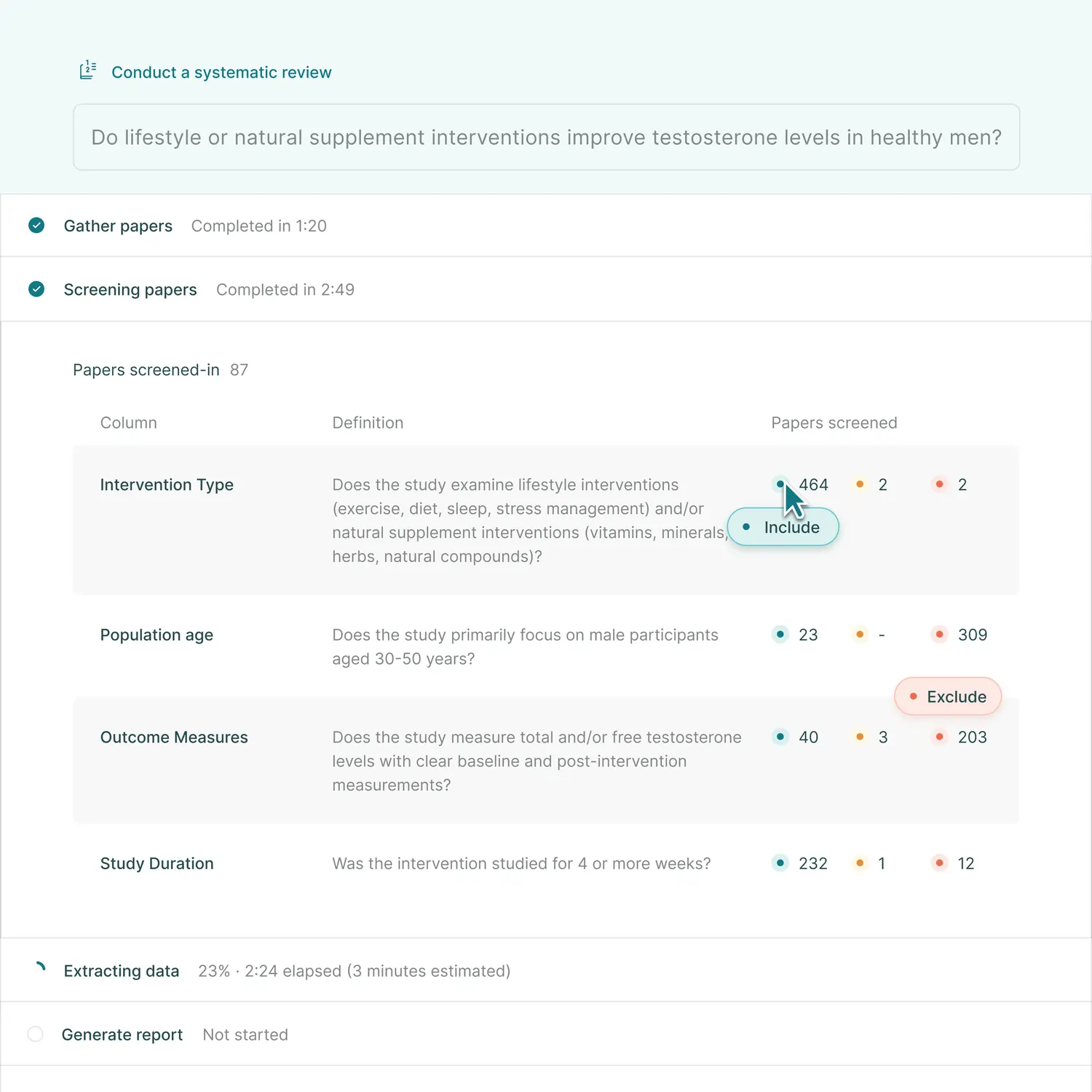
Elicit was purpose-built for systematic review teams. Automates screening with inclusion/exclusion criteria, generates strength-of-evidence ratings, produces PRISMA-style reports. Teams report 80% time savings because Elicit handles sorting, tagging, and extracting while researchers analyze and interpret.
🏹 Accuracy and Citation Transparency: Trust Matters
SciSpace backs AI answers with paper citations you can verify instantly. Click through to check original context and methodology. The catch: less reproducible for strict systematic searches compared to traditional Boolean methods, per academic reviewers.
Elicit positions itself as the most accurate AI for scientific research, supporting every claim with sentence-level citations. No black-box summaries—you see exactly which sentence in which paper supports each data point. Critical for peer review and grant proposals.
🔗 Workflow and Platform Experience
SciSpace: Centralized workspace with customizable tables, AI columns for data extraction, library for PDF management, notebooks for synthesis, browser extension for seamless paper capture, and export formats (CSV, BIB, RIS, Excel, XML). Team plans add admin controls and collaboration features.
Elicit: Interactive research library organizing saved sources, research alerts tracking new literature on specific topics, multi-step workflows guiding question-to-report processes, and table customization for domain-specific data points. Team and Enterprise tiers add shared workspaces and custom workflows.
Integrations and Research Environments
SciSpace connects to Google Scholar, PubMed, arXiv, and institutional library systems. Chrome extension lets you save papers mid-browse. Mobile apps (iOS/Android) sync your library across devices. Team collaboration includes shared projects and comment threads.
Elicit imports from Zotero for existing reference management. Web-based platform works across academia and industry without desktop installs. Used by systematic review teams, policy researchers, and R&D labs needing reproducible evidence pipelines. No mobile app yet—desktop browser only.
💸 Pricing Comparison: Budget Reality Check💸
💰 SciSpace Pricing (annual billing):

💰 Elicit Pricing (annual billing):
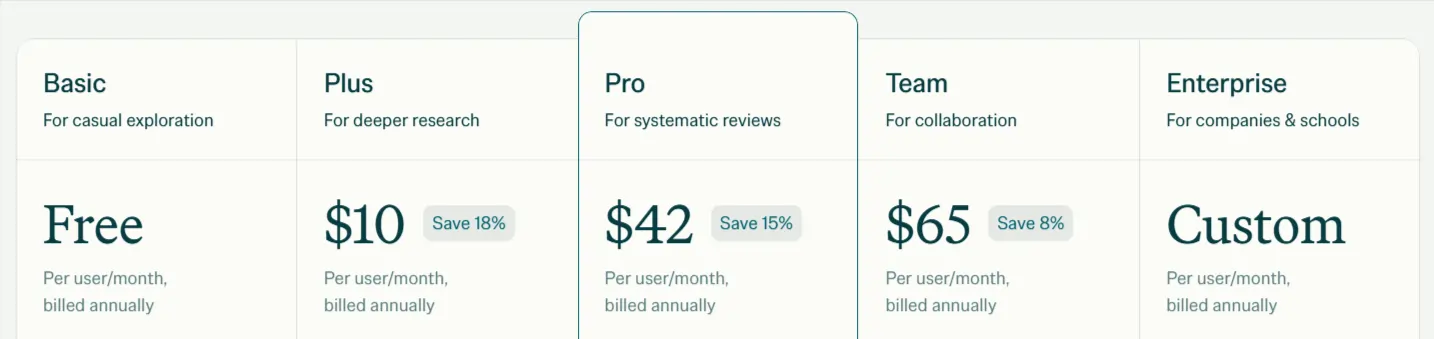
SciSpace costs more for bundled writing tools. Elicit stays cheaper focusing purely on research analysis.
🚥 Pros and Cons: Honest Breakdown 🚥
❓ FAQs Related to SciSpace vs Elicit
Is SciSpace better than Elicit?
Depends on your task. SciSpace wins for exploratory research and writing. Elicit wins for systematic reviews and data synthesis.
Can Elicit replace a systematic review?
No. Elicit automates screening and extraction but researchers still analyze, interpret, and write the review.
Can SciSpace write my literature review?
Partially. It drafts sections and summaries but needs human editing for publication quality.
Which AI tool is best for reading research papers?
SciSpace Copilot for interactive explanations. Elicit for comparative data extraction.
Is Elicit free?
Yes. Basic plan offers unlimited semantic search and limited monthly extractions.
📞 Final Call: Pick Your Research Weapon
PhD candidates writing dissertations across multiple chapters need SciSpace's writing suite and discovery breadth. Clinical teams running PRISMA reviews need Elicit's extraction precision and evidence ratings.
Stop guessing. Match the tool to your actual workflow—not the demo that looks coolest. Your deadline won't negotiate.